
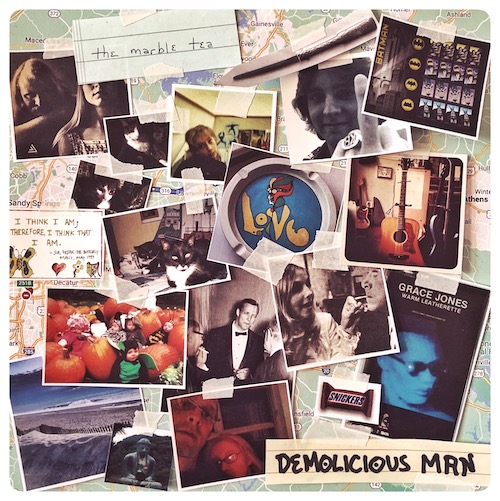
DOWNLOAD THE 60 SONG COLLECTION 465mb
DOWNLOAD THE LINER NOTES / LYRICS 18mb
All the Marble Tea you never knew you needed!
Here are sixty songs culled and collected from these very pages – or trapped for years on my hard drive or sundry cassettes – that I’ve assembled into one massive basket of odds and sods for your bemusement. None of these are available on any official release. I tried to get them to all live sonically somewhere in the same neighborhood, but as they span nearly twenty-five years and multiple sonic creation devices, you may need to adjust your volume or tone knob on occasion.
Download it for free above, or, if you’re inclined, you can purchase this rarities compilation on Bandcamp or make a donation to the KBJ Needs New Monitors Fund. And I thank you.
If you’d like to read the wonderful liner notes by Joey Madia (that is both heartwarming to me and thorough in its insightful and literate examination of our friendship and the work I’m trying to do) without downloading the whole package, you can do that right now:
A Lucky, Lovely Lover: Celebrating the Whimsical Wisdom of Knight Berman, Jr., aka The Marble Tea
On the occasion of his sixtieth birthday and the release of Demolicious Man
It was in 2002, after a somewhat reluctant and certainly not triumphant return to New Jersey after a five-year absence, that my Aunt Annette introduced me to the Book Bin. Nestled on the main drag in the charming and aptly named Point Pleasant—where I had graduated from high school fifteen years earlier—the Book Bin boasted two of the most spiritual smells in the world: Nag Champa incense and old books.
Behind the counter were two bespectacled Old Souls named Knight and Kate. My aunt had known them for a while and when she said, “There’s someone you have to meet,” I always listened. After all, that’s how she introduced me to Jonathan Livingston Seagull when I was a timid and struggling ten-year-old.
There are some days you always remember, because they are days that change your life.
That day in 2002… that was one of those days.
As I scanned the glass display cases at the front of the store, my eyes going wide at the visual feast, I listened to the lyrical voices coming from behind the counter. Part windy whisper, part soothing sage, Knight and Kate were not just in that charming old Jersey Shore book store… they were of it.
For the next decade, I spent hour upon pleasant, Einstein-time hour buying stacks of books—my home office still smells of that wonderful Book Bin smell—and items from the cases in the front, where the conversations were always enlightening, energizing, and exceptional.
Just like Knight and Kate.
During that decade, Knight and I began to talk more and more about our mutual love of music, until it was clear that we were meant to work together. Twenty years later, we have collaborated on half a dozen musicals, film soundtracks, spoken word and staged theatre pieces, audio drama recordings, and more.
Through it all, there has been the Marble Tea, which is really why we’re here.
When Allen Ginsberg was a struggling young poet in Newark, New Jersey, he sought assessment and direction from the old-school physician and avant-garde poet William Carlos Williams who, after reading Ginsberg’s poetry, advised him to find his own voice, discard the traditional rhyming and meter schemes, and to always remember to practice the mantra, “No ideas but in things.”
Using this criterion alone, Williams would see a lot of merit in the works of the Marble Tea. Knight has a beautiful way of expressing the ideas behind things—average, ordinary, everyday things—and he often leaves those ideas beautifully (purposely) unfinished.
Instead of pat answers and pop proclamations, he unassumingly invites the listener into his lo-fi, whimsical world like the Persian poet Rumi would an exhausted, world-weary traveler. The music of the Marble Tea is the food, the drink, and the comfortable bed for the night.
As you walk the rooms of the gracious guesthouse that is this sixty-song collection, I hope the following verbal scribbles and cerebral sketches—organized by theme—offer a little touch of insight into one of my closest friends, and favorite singer-songwriters, and what makes his music shine so bright in a world of darkened hallways and thick, foreboding forests.
If you are a longtime fan of the Tea, then you are familiar with Knight’s sentimental “goodbye” songs. Two of my favorites are “Say Goodbye” and “Goodbye Old Maple” (the latter about a tree under which I spent many pleasant hours). This collection gives us “Goodbye to Summer.” If you’ve spent any amount of time at the beach in the summer, this little gem is full of all the sandy, sunny tropes that will fit into a flamingo-print beach bag, driven along by Knight’s signature psychedelic arrangements.
Another prevalent subject area for Knight is his pets. From “Hoga-rama” to “Banana Cat” and “Ou est le Drake,” he has an insightful way of humanizing those furry, friendly creatures who make a pet-lover’s life more full. Here we get “Your Whiskers Keep Me Up at Night”—a 46-second piano-based blues number—and “My Little Animals.” As Knight says “Hello kitty!” at the start of this jazz-based tune, you’ll feel yourself smile, and it will last beyond the button and into the rest of your day.
Some of the music that Knight writes is born out of specific assignments for clients, challenges assigned by the music production and composition groups with which he is actively involved—his love of learning is one of my favorite things about him—and his impressive musical knowledge spurring him on to constant experimentation. Three tunes in this collection showcase his range: “Don’t Freak the Butterfly” (funk, techno, and disco, with a neat bongo beat, inspired by Al Franken’s Stuart Smalley); “A Great Moving Wave of Bliss” (inspired by Brian Eno’s ambient experimentations); and “Good Gracious Baby” (a blood-pumping honkytonk howler).
As mild-mannered and hippie-proclivitied as Knight might be, he will—if the mood or an event strikes him hard in his sizable social justice soul—produce a political tune that has all of his quirky Knight-ness while also speaking mega-truth to power. “Temporarily Not the K-Man,” about a guy he knows getting fired from his job for sneaking off to the bathroom, is sonically like Dylan’s “Bear Mountain Picnic” and lyrically like his political protest songs. “Temporarily” verbally skewers big government, bigger corporations, and injustice, and features perhaps the best vocal lead-in to a harmonica solo ever. Another Dylan-esque room in this guesthouse is “You Really Piss Me Off,” because even indie hippie guys get angry now and then… Recalling “Positively Fourth Street” and Ra’s “Waste of Space,” it features a repeated Lou Reed–like “whoo!,” which adds a little lightness to the uncharacteristic lack of love.
On the other end of the spectrum are comedic songs like “Wild Turkey” and “Tryptophan” (the connection between the two in this collection kind of comedic in and of itself). “Wild Turkey” is all of fifteen seconds. Knight’s voice is blues-gritty and boisterous, and, although I thought it was about bourbon… maybe it’s not. “Tryptophan” is a song about the science of why everyone gets “sleepy after Thanksgiving dinner.” It’s the perfect song for a Saturday morning kids show… and we nearly had that happen. But that’s another story…
Songs like “Tryptophan” are important to understanding the scope of the overall catalog that KBJ/the Marble Tea has produced, because the subject matter from which he draws his inspiration is breathtaking in its diversity. One of his many wells of inspiration is Famous People. Listen closely to some of the songs and you’ll hear lots of names in passing, merely players in the poem, but not exactly the stars: actors like Amy Poehler, Natalie Wood, Tom Hanks, and Buddy Hackett; writers like TS Eliot and Italo Calvino. Then there are the songs that focus on the famous. One, “Truman’s Hat,” about Capote, is a previous release. But Demolicious Man does feature two of these kinds of tunes. The first is “Nine Stories,” about a collection of short stories by JD Salinger. Warning: plot spoilers abound! The other is “Listening to Richard Brautigan,” which (similar to “Truman’s Hat”) is part biography and part synergy, as Brautigan’s well-known phrases and images find themselves intertwined with Knight’s naturally playful lyrics. There’s another song I’d like to lump in here, called “Hey! You in the Tuxedo!” With an opening riff reminiscent of Pete Townshend’s “Let My Love Open the Door” and a guitar solo using phasing and delay, this tune never names the famous person, although Knight, upon reading this piece, informed me it is about his father.
Speaking of inspiration, I know many musicians and songwriters, but Knight is one of the most knowledgeable when it comes to other indie bands, and the history of modern music. Although my iTunes player is full of bands and songwriters to which other musicians have introduced me, there is no one that has broadened my musical experience like Knight. He often sings about the bands that he loves, and some of his best songs are homages to the musicians who’ve inspired him the most through the decades. Some of the more obvious to me when listening to the tracks on Demolicious Man are the Smiths, Syd Barrett, the Velvet Underground, Robin Hitchcock, and David Bowie. “Checks in the Mail” not only sounds like an old LP (I still play mine from the eighties, scratched, warped, and weathered though they are) but an old LP of David Bowie’s Hunky Dory (specifically “Kooks”). Another inspiration is The Monkees, echoing most especially in “Painting a Cat” and “Petri Dish.” Some of the others in which you might hear some or all of these inspirations are “Everywhere I Go I See You,” “Old Letter Opener,” “Mine all Mine,” and “Suburban Girls on Tranquilizers” (the title is both the hook and the central, repeated phrase).
As much as I love Knight’s arrangements (and for our musicals, he’ll tell you I always request more of his lyrical flutes and atmospheric cellos), many of my favorite songs are ones where the primary instrument is the acoustic or unprocessed electric guitar. I categorize these songs as “gorgeous.” There are five in this collection that I have to mention here. “Pumpkin Postcard” is another fine example of WC Williams’s “no ideas but in things.” “Time Is Like a Dream at Dawn” (which abruptly ends… like a dream!) features Phillip Seymour Hoffman in the central role, which makes it twice as haunting as the arrangement does alone. “Kimono Flesh” features an acoustic opening that recalls to me “Taurus,” written by the late Randy Wolfe of Spirit (unfortunately known by many only because of its connection to Zeppelin’s “Stairway to Heaven”). “Janie Said” is an homage to similarly titled/themed songs by Lou Reed and the Velvet Underground. Then there is the electric version of “I Wish It Would Snow,” which I have listened to 462 times since February 10, 2008. Since he never released it, he must have shared it with me while we were celebrating his birthday that year.
By now, I am sure you are seeing the interconnectedness of the styles, themes, and inspirations that go into the always-boiling pot that makes the Marble Tea. Nowhere are they more intertwined than in Knight’s story songs—especially the ones with specific locations. “Raining California,” “To the Lake,” “Inlet,” and “Vanishing into the Sea” are all water-based. “Inlet” features the line “I’ll tell you a story,” while “Vanishing…” is a waltz with an Eastern European feel and a beautiful accordion accompaniment. “Why Can’t I Say What I Mean?” is sung by a man walking by the seashore; the chorus has an epic/anthemic energy, like the 1970s country/rock crossovers performed so memorably by Elvis.
Another song in this theme that is meta in its storytelling is “Falling,” with the line, “It’s like I told you.” Since Knight is an even better listener than he is a talker, he also gives us “316 (Moonglow Edition),” where, although the bridge is spoken word, the song references another singer as the star: “We were listening to David J.”
Full-on story-songs in this collection include “The Real’s So Hard to Find”—a raucous blues number about a cosmic traveler imprisoned on Earth, buoyed by a bit of slide guitar; “Homemade Sour Cream Coffee Cake”—the title is the hook as well as the chorus. I defy you not to sing along as you listen numerous times in a row, anticipating the button “And I’ll never be the same” each and every time. Deep-dive fans of the Marble Tea will recognize the thematic similarities to “TS Camelot” and “Cliff’s Stupendous Margaritas.” “Cheese,” about a trip to the photographer and then to pick up the prints at a one-hour drugstore development counter, is absolutely carnival-esque.
Two of the standout story-songs are also the most self-reflective and mournful: “Dinner at Six,” about the drudge of the workaday world (“another long day of reluctant diplomacy”) features slide guitar and some of Knight’s most evocative lyrics. Along the same lines is “Welcome to the Neighborhood,” a beautiful keyboard and acoustic guitar composition about a move, and the scariness of newness.
The subtitle of this essay, “A Lucky, Lovely Lover,” is a nod to Knight’s particular brand of quirky, perky pop when it’s time to sing about love. Although his love songs at times remind me of Jonathan Richman, the Magnetic Fields, Andrew Bird, and Lloyd Cole, with their jingly-jangly guitars, floor toms that suddenly scream The Monkees!, and need-a-careful-listen lyrics, nothing quite inspires le cœur like a love letter signed by the Marble Tea. Songs like “Lion Water Sign” and “Such a Beautiful Bird” (the latter of which at times sounds as though it is a duet with an actual bird) make me grateful to be in love; if I wasn’t, they’d make me want to be. “Don’t Look at Me that Way” has a bossa nova beat that puts it in the same realm as a previous release, “Who’s Been in Your Dreams.”
Of all the love songs in this collection, “Her Name is Pretty” is a highlight. I have been enjoying the electric, fully arranged version of this pop gem since 2012. Listen to this one with a good set of headphones because, although it is stripped down acoustic in its arrangement, some of the support instrumentation of the previously released version is whispering in the background. “Her Name is Pretty” also boasts one of my favorite Marble Tea lyric lines: “She’s loved a lot of men, and none of them were me, at least none of them were me until one of them just happened to be me… you know, not one of those guys over there.”
If you’re new to the Marble Tea, that’s the kind of high-end, “hey… did he just really craft that crazy, amazing line?” you can expect in just about every song.
You cannot consider the considerable body of work that Knight has produced in the past forty-some years without taking a serious look at his penchant for Mantric Wisdom. Like any worthy teacher you might meet on your spiritual journey, Knight gives us plenty of space to create our own meaning, implanting little MacGuffins—a term Alfred Hitchcock popularized for an object the hero is chasing—and weaving tapestries of character, tone, and melody that are also akin to fairy tales. In our nearly weekly Sunday morning gabfests, we talk about the importance of keeping our candles lit, our vibration high, and doing our art for the sake of the art without worrying too much about the outcomes. Or, as he sings in “The Whole Point,” supported by wispy waves of cellos and horns: “And so it goes… I keep looking for a way to make my lows much higher than they are today.”
Knight uses mantra-like lyric lines in many of his songs, some of which I’ve already mentioned. Sutras set to music, with the title text often the only lyrics, they are all about frequency and tonality. Examples include “Let’s Play the Quiet Game,” a mantric lullaby lasting 64 seconds, with a soothing music box arrangement and cool, cosmic keyboards. “Blueberry Blue” is the kind of song you might hear on the soundtrack to The Monkees’s Head, with its psychedelic Far Eastern melodies and trippy Oms and Ahs. “Transit Ford in the Fourth Dimension” is an instrumental, except for the mantra: “I’m slowly coming through my skull and out my face.” “Nothing but Nothing,” “Nowhere Angel,” and “Travel Light on Your Road” (cosmic hippie funk with signature Marble Tea sampling) also consist of bare bones lyric-mantras. “Astronomers” is truly haunting.
This is not to say that Knight can’t sustain a spiritual–philosophical theme beyond a single line. Songs like “The Buddha or the Bomb” feature traditional verse and chorus structures with lyrics worth extended contemplation: “Any thing I touch is being touched by a thing called me.” In “Like Everyone,” Knight takes John Lennon’s comments on the Maharishi’s less than honorable practices and flips them into the much more accurate and inclusive, “everybody and their monkey’s got something to hide.”
“Never Trust a Seagull (in Penguin Pajamas)” is another psychedelic tune reminiscent of The Monkees. I could easily imagine either Mickey or Peter singing it with gusto and panache. “Theoretically Being There” gives us big spiritual paradoxes delivered along fuzzy 1960s power chords and chaotic phasing with a hook reminiscent of the theme from Sesame Street.
The last three songs I want to mention are ones that I’ve been listening to for years. “Love Bomb” is one of the first Marble Tea songs I ever heard, in 2002. “If Wishes Were Fishes” and “Life on the Moon” invite multiple listens to unpack fully their karma-cosmic Wisdom philosophy and lo-fi pop sensibilities.
Demolicious Man is Knight’s gift to us on the occasion of his sixtieth birthday. Give the gift of a listen to this collection, and let’s let the Mantric Wisdom and Lucky, Lovely Love wash over us all in an eternal feedback loop of good vibes, lit candles, and energized cosmic communion.
Joey Madia
The Creative Cottage, Ohio
February 2022
 Presto MusiCo